
Home / Guides / Binance trading bot, tested before it trades
Binance trading bot, tested before it trades
Binance is one of the ten exchanges M Alpha Core works with. You scan a market on a full year of data, read the report and then let your own bot trade Binance perpetual contracts on your own account, with a key that can trade but never withdraw.
Last updated:
Binance futures: perpetuals in USDT and USDC
For a trading bot, the part of Binance that matters is its futures market: perpetual contracts that settle in USDT or USDC and have no expiry date. A bot can go long or short, use leverage and stay in a position for days without rolling anything over. Next to crypto, Binance lists perpetual contracts on some traditional markets, for example gold. Which of them are available to you is decided by Binance.
Binance offers sub accounts. According to its sub account FAQ, the feature is available to users who complete identity verification, regular users can create up to five sub accounts by hand, and each sub account can hold up to 30 API keys. Futures have to be enabled inside the sub account before a key there can trade them.
Binance's own API guide recommends restricting a key to trusted IP addresses before you enable anything beyond reading. That fits the way M Alpha Core works: your bot runs on one server with one fixed address, and the key only needs to work from there.
Gold, stocks and commodities on Binance
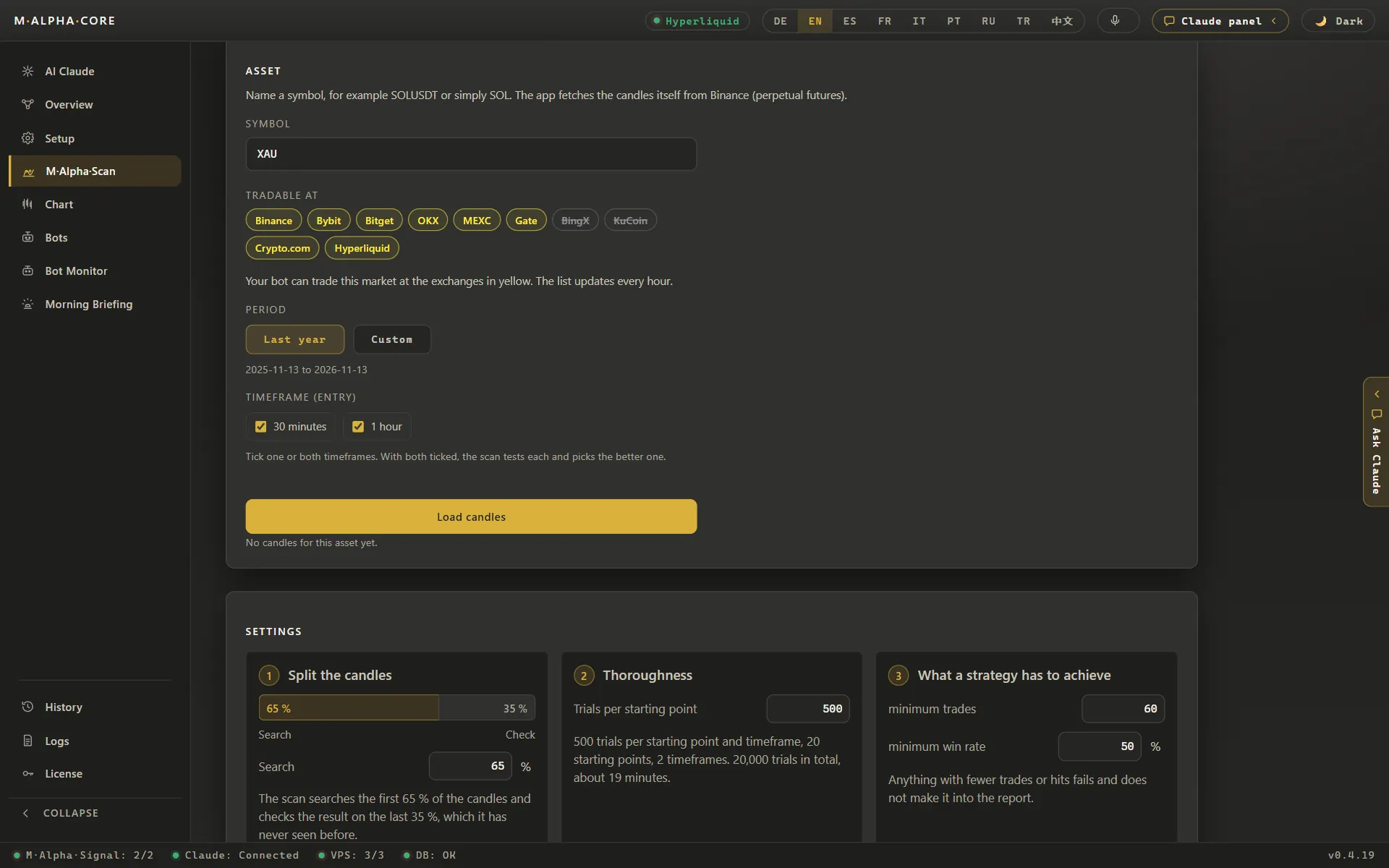
Binance is one of the broadest choices for markets beyond crypto. In the app's market list of November 13, 2026, Binance had 758 perpetual markets, and every non crypto market M Alpha Core scans was among them: gold (XAU), silver (XAG), platinum, palladium, copper, WTI and Brent oil, natural gas, the S&P 500 (SPY) and the Nasdaq 100 (QQQ). Single stocks such as Nvidia, Apple, Tesla, Microsoft and Coinbase were listed as well.
All of these settle in USDT on Binance. USDC contracts existed for 38 markets on that day, BTC and ETH among them. If your sub account holds USDC and the market has a USDC contract, the bot trades that one; otherwise it uses USDT.
Source: market list of the app, November 13, 2026.
How M Alpha Core works with Binance
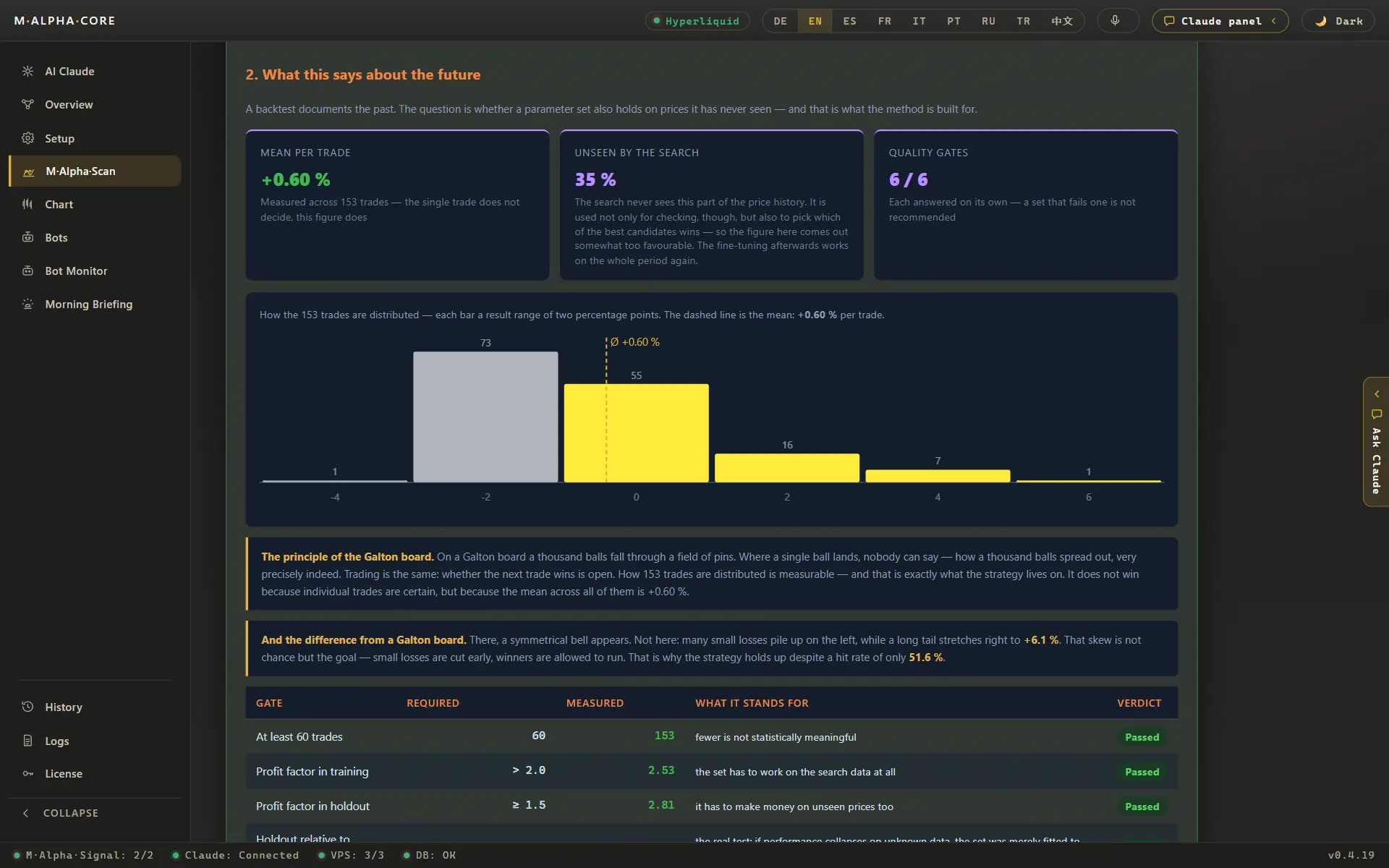
M Alpha Core has one built-in strategy. The scan finds the best settings of that strategy for your market: it searches on the first 65 % of a year of data and checks the result on the last 35 %, data the search never saw (out of sample). The report shows every trade, the profit factor and the drawdown. How we test explains the method in detail.
Your bot on Binance
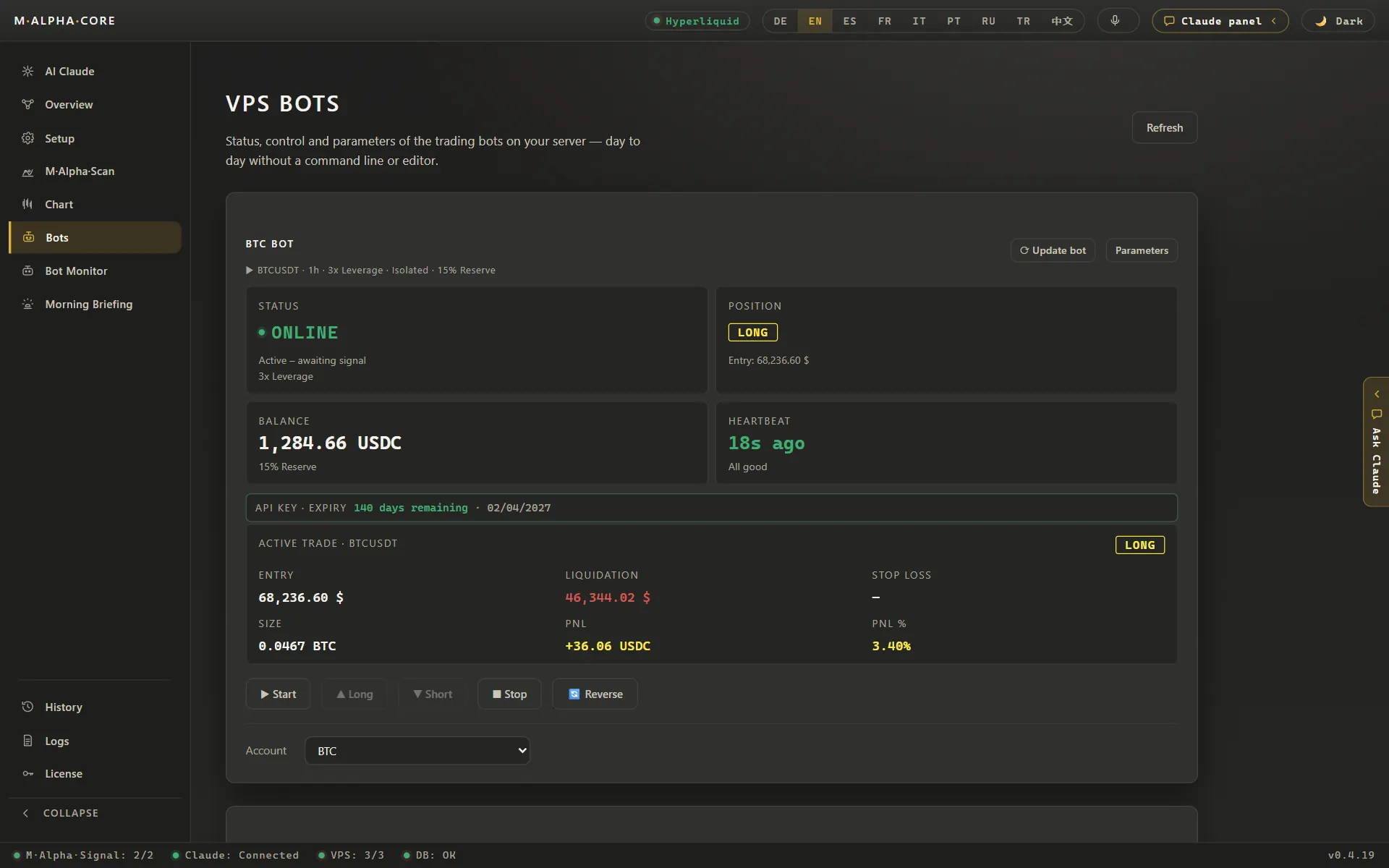
Your bot connects to your Binance sub account with your own key and trades the perpetual contract of your market in USDT or USDC, depending on what Binance offers your account. Every trade lands in your Telegram, and a panel in your browser lets you go long, short, reverse or stop.
Every trade your bot makes on Binance also lands in the app's trade history, which you can export as a CSV file for your tax advisor.
Binance in M Alpha Core at a glance
| Contract type | Linear perpetual contracts |
| Settlement currency on Binance | USDT or USDC, depending on what Binance offers your account |
| Order size counted in | Coins |
| Passphrase for the Binance key | No |
Smallest order on Binance
When we read Binance's public market data on November 5, 2026, the smallest order value was $50 for BTC, $20 for ETH and mostly $5 for other markets. The order value counts, not the margin: with 5x leverage, a $50 BTC trade ties up only $10 of margin, yet it still has to reach the $50. Binance counts orders in coins, so the bot only rounds your amount down to the step Binance allows. If a trade falls below the minimum, Binance rejects it and the bot reports this on Telegram.
Stop loss on Binance
Binance handles stop orders for futures through its own order type. The bot places its protective stop loss in the form Binance expects and removes the old stop when it reverses or closes a position, so no forgotten stop is left behind.
Setting up your Binance bot step by step
- Scan your market in the app and go on only if the result holds up on the unseen 35 %.
- On Binance, create a sub account for this bot and move the bot's money into it.
- Create an API key in that sub account with futures trading rights only, withdrawals off, bound to your bot server's IP address. Inside the sub account, enable futures first. Then create the API key there.
- Enter the key in the app, which sends it to your own server, then start the bot.
Button names on Binance change from time to time, so we link the official help pages instead of copying them:
- How to create API keys on Binance (official Binance page)
- Binance sub account functions and FAQ (official Binance page)
Leverage, margin and liquidation on Binance
On Binance, leverage and margin mode belong to a single market. The bot sets both for your market before the first trade, while no position is open, and leaves your other Binance markets untouched. If Binance allows your account less leverage than you chose, the bot takes the highest value Binance accepts and tells you.
Leverage makes gains and losses larger. In one ETH scan (ETHUSDT, 30 minute chart, November 6, 2025 to November 6, 2026) with 116 trades, the worst move against a single trade was 15.64 %, so anything above 6.39x leverage would have meant liquidation of that trade. The report shows this limit for your market, and the leverage calculator lets you try your own numbers.
Binance trading fees and M Alpha Core costs
Binance sets its own trading fees and funding rate, and both can change, so check the official Binance fee page for your account level. M Alpha Core costs $49 a month for Standard, $69 for Pro or $1,490 once for Lifetime (see pricing), plus about $12 a month for a small server.
Where Binance futures are not offered
Whether an exchange serves your country is set by the exchange. Check its terms. Binance has announced that its futures and derivatives products are not available in some countries, for example Germany, Italy and the Netherlands. See: Binance announcement on futures availability. If one exchange is not open to you, one of the other nine may be.
Other exchanges besides Binance
Bybit · Bitget · OKX · MEXC · Gate · BingX · KuCoin · Crypto.com · Hyperliquid
Binance trading bot: questions and answers
Which markets can I trade on Binance?
Crypto plus gold, silver, platinum, palladium, copper, oil, natural gas, the S&P 500, the Nasdaq 100 and single stocks as USDT perpetuals, according to the app's market list of November 13, 2026. For 38 markets, BTC and ETH among them, there was also a USDC contract.
Do I need a Binance sub account?
We strongly recommend one per bot. Each strategy then has its own balance and its own risk. If one strategy has a bad run, it cannot pull money from the others.
How much money do I need on Binance?
Enough that each trade stays above Binance's minimum order value. On November 5, 2026 that was $50 for BTC and $20 for ETH per order, and mostly $5 for other markets.
Does M Alpha Core use Binance's own grid or copy bots?
No. M Alpha Core runs its own bot on your server with the settings from your scan. Binance's built-in bots are a separate product of Binance.
Compare M Alpha Core
Side by side with other bot tools, with sources for every statement about them.
Exchanges in M Alpha Core: Bybit · Bitget · OKX · MEXC · Gate · BingX · KuCoin · Crypto.com · Hyperliquid
All figures come from backtests on past market data. No result is a promise of future profit. Trading, especially with leverage, involves high risk. M Alpha Core is a software tool, not investment advice.