
Home / Guides / DCA vs grid vs signal bot
DCA bot, grid bot or signal bot: which one fits?
Most trading bots belong to one of four families. Each one earns money in a certain kind of market and loses it in another. This guide explains how DCA bots, grid bots, signal bots and strategy bots work, where each one breaks, and how to test any of them.
Last updated:
The four families at a glance
| Bot type | How it trades | Good market | Weak spot |
|---|---|---|---|
| DCA bot | Buys more in steps as the price falls, sells once it recovers | Dips that recover | A long decline that does not recover |
| Grid bot | Places buy and sell orders at fixed steps inside a price range | Sideways swings inside the range | A breakout that leaves the range for good |
| Signal bot | Follows alerts from a chart tool or a signal group | Depends entirely on the signals | Untested or late signals |
| Strategy bot | Runs fixed rules for entry and exit, long and short | Depends on the rules, often trends | Long choppy phases without a trend |
None of these is the best bot. Each one is a bet on a certain kind of market. The useful question is which bet you are making and whether you have tested it.
DCA bots
DCA stands for dollar cost averaging. A DCA bot opens a position and, if the price moves against it, buys more at set steps. Each extra buy lowers the average entry price. When the price recovers a little, the whole position closes with a small profit. Then the cycle starts again.
Why people like it. A DCA bot closes most of its cycles in profit, so the record looks calm for a long time. In a market that dips and recovers, it works well.
Where it breaks. In a long decline, the bot keeps buying. The position grows with every step while the price keeps falling. If the safety orders are used up, the bot sits on a large loss and waits. With leverage, the growing position can be liquidated. A DCA bot can win fifty cycles and then give back all of it in one bad month. Its win rate says almost nothing about its risk.
What to test. The deepest decline in your test period, how much capital the bot would have needed to survive it, and the largest open loss along the way. Test on a period that contains a real bear phase, not just a year of rising prices.
Grid bots
A grid bot divides a price range into steps and places a buy order below the current price and a sell order above it at every step. Each time the price swings down a step and back up, the bot earns the gap between two orders. The more the price swings inside the range, the more small profits it collects.
Why people like it. In a sideways market, a grid earns steadily and needs no forecast of direction. It is easy to understand.
Where it breaks. When the price leaves the range. If it breaks out upwards, the bot has sold everything on the way up and holds no position while the market rallies. If it breaks down, the bot has bought at every step on the way down and holds a full position at a loss. A grid needs someone to watch the range and reset it.
What to test. How often the price left your range in the test period and what the bot held at that moment. Include fees: a grid makes many small trades, and fees take a fixed bite of each.
Signal bots
A signal bot does not have rules of its own. It follows signals from somewhere else: an alert from a chart platform, a message from a signal group or a webhook from another service. The bot turns each signal into an order.
Why people like it. You can automate a strategy you already follow, or the calls of a trader you trust, without writing a bot.
Where it breaks. The bot is exactly as good as the signals, and many signals have never been tested in a way you can check. A signal group sends the same trade to everyone at the same moment, and late subscribers get worse prices. Every link in the chain (alert, webhook, receiving service, exchange) is a point of failure.
What to test. Ask for the full record of the signals, every trade, including losers, over at least a year. If it does not exist, you are the test.
Strategy bots
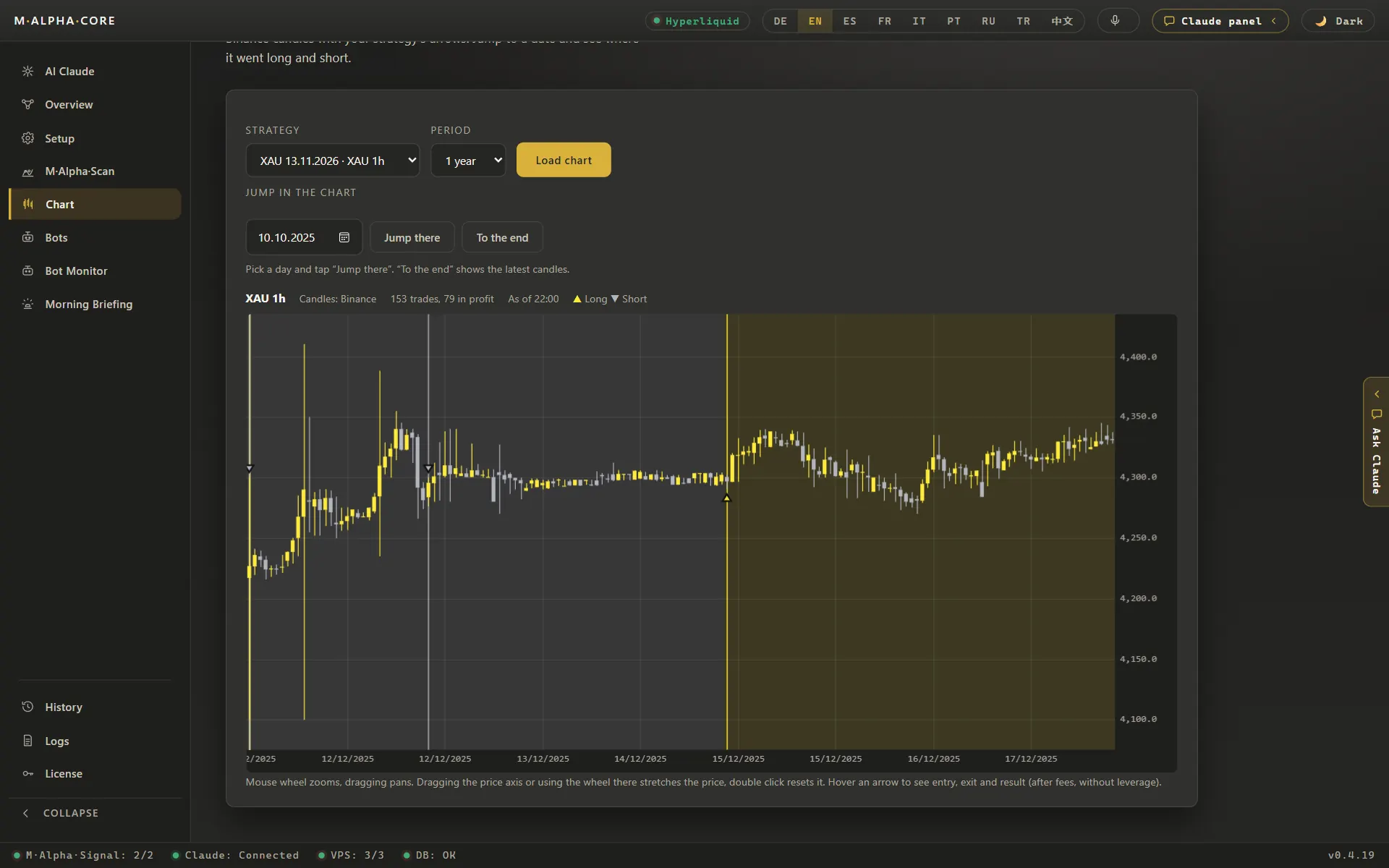
A strategy bot runs a fixed set of rules for when to enter and when to exit, often long and short. Many follow trends: they buy when the price shows strength and sell or go short when it shows weakness. The rules are known in advance and give the same trades on the same data every time.
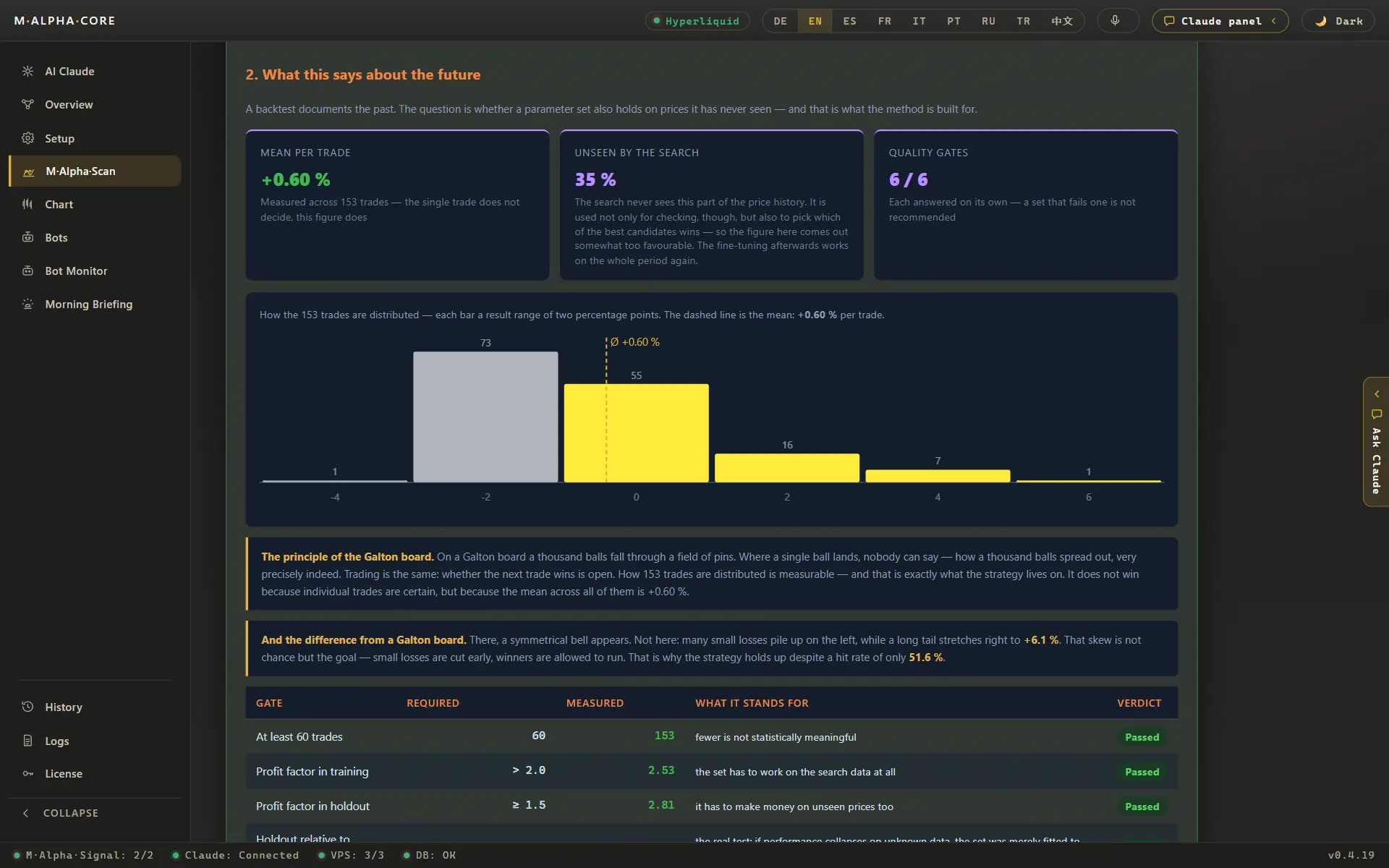
Why people like it. Because the rules are fixed, they can be tested on a full year of past data and on a part of the data the search never saw. The risk of each trade can be measured.
Where it breaks. In long choppy phases without a trend, a trend strategy enters, gets stopped, reverses, gets stopped again. A run of small losses is normal for this type. If the rules were fitted too closely to the past, they also break on new data, which is exactly what a test on unseen data is meant to catch.
What to test. The profit factor on data the search never saw, the number of trades, the longest phase without a new high, and the worst move against a single trade with the leverage that move would have allowed.
Leverage changes every bot type
All four types become far more dangerous with leverage, but in different ways. A DCA bot with leverage grows its position into a falling market, so the liquidation price comes closer with every safety order. A grid bot with leverage holds a full leveraged position after a breakdown. A signal bot inherits the leverage of whoever sends the signals. A strategy bot can be measured: the worst move against a single trade tells you the highest leverage that trade would have survived. In an ETH example from M Alpha Core, the worst move was 15.64 %, so anything above 6.39x would have liquidated that trade. Try your own numbers in the leverage and liquidation calculator.
Which one fits you?
- You believe a market will stay in a range for a while and you will watch it: a grid bot can fit.
- You want to build up a position in an asset you would hold anyway, without leverage: a DCA bot can fit, as long as you can carry the full position.
- You already follow a source of signals with a long, checkable record: a signal bot can automate it.
- You want rules that are tested on unseen data, with the risk of each trade in numbers, long and short: a strategy bot fits.
Mixing types on one account mixes their risks. If you run more than one, give each bot its own sub account, so a bad run of one cannot use the margin of another.
Where M Alpha Core fits
M Alpha Core is a strategy bot. It has one built in strategy, M Alpha Signal, which trades long and short. The scan finds the best settings of that built in strategy for your market and checks them on the 35 % of a year the search never saw. The report shows the number of trades, the profit factor on both parts, the result with and without leverage, the worst move against a single trade and the leverage limit. Your bot then runs on your own server with your own trading only key. It does not run grids and it does not average down.
Real results are on the gold, S&P 500 and stock pages. The methodology page explains every figure. If you are comparing tools that offer DCA or grid bots, see M Alpha Core vs 3Commas and M Alpha Core vs Pionex.
How to test any bot before real money
- At least a year of data, including a falling phase.
- Fees and funding included.
- A part of the data kept aside and used once at the end.
- The worst case in numbers: deepest drawdown, worst move against a trade, largest open position.
- A dry run on live prices before real money.
- A first stake you can afford to lose.
The guides on how to backtest a trading strategy and how to test a crypto trading bot go through these steps in detail.
Frequently asked questions
What is the difference between a DCA bot and a grid bot?
A DCA bot buys more as the price falls and sells once it recovers. A grid bot places buy and sell orders at fixed steps inside a range and earns on swings within it.
Which bot type is the safest?
None is safe. Each one loses in a certain market: DCA in long declines, grid on breakouts, signal bots on bad signals, strategy bots in choppy phases.
Why do DCA bots show such high win rates?
They close most cycles with a small profit. The risk sits in the few cycles that do not recover, which can cost more than many wins earned.
What happens to a grid bot when the price leaves the range?
On a breakout upwards it holds no position. On a breakdown it holds a full position at a loss until you reset the range.
Is a signal bot the same as a strategy bot?
No. A signal bot follows signals from elsewhere. A strategy bot runs its own fixed rules, which can be tested on past data.
What kind of bot is M Alpha Core?
A strategy bot with one built in strategy that trades long and short. The scan finds its settings for your market and tests them on unseen data.
Does M Alpha Core offer grid or DCA bots?
No. It runs one tested strategy per bot. It does not run grids and does not average down.
How do I test a DCA or grid bot?
On at least a year of data with a real falling phase, with fees, and with the largest open position and drawdown in numbers.
Can I run different bot types together?
Yes, but put each on its own sub account so the risks do not mix.
Compare M Alpha Core
Side by side with other bot tools, with sources for every statement about them.
Exchanges in M Alpha Core: Binance · Bybit · Bitget · OKX · MEXC · Gate · BingX · KuCoin · Crypto.com · Hyperliquid
Related pages
All figures come from backtests on past market data. No result is a promise of future profit. Trading, especially with leverage, involves high risk. M Alpha Core is a software tool, not investment advice.