
Paper trading a bot before real money
If you are sure about a market, you can start with real money. If you are not, try it on paper first. M Alpha Core has two ways to do that: a dry run that only writes down what the bot would do, and a testnet bot that trades with play money.
Last updated:
Why paper trading after a backtest?
A backtest tells you how rules would have traded in the past. It cannot tell you whether your setup works today: whether the bot reaches the exchange, whether the symbol and the time frame are right, whether your server stays awake, whether the signals arrive at the times you expect. Paper trading checks exactly these things, on live prices, without risking money.
It also shows you how the strategy behaves in the current market. The test period may have been calmer or wilder than the weeks you are in now. Watching a few signals arrive in real time is a good way to learn what the bot will do before it does it with your money.
Two ways to practise in M Alpha Core
| Dry run | Testnet bot | |
|---|---|---|
| What it does | Writes down what the bot would buy or sell, sends no orders | Places real orders on the Hyperliquid testnet with play money |
| Exchange account needed | No, without an account it counts with an imagined $1,000 | A Hyperliquid testnet account with play money |
| What you see | Every signal as a Telegram message starting with DRY RUN, plus the bot log | Balance, positions and profit or loss of the testnet account in the app |
| What it checks | Server, signal, timing, symbol, time frame | All of that plus real order handling on an exchange |
| Exchanges | Any | Hyperliquid testnet |
Both modes use exactly the settings from your report, and both receive the same signal from our signal server as a live bot would. The difference is only where the order goes.
The dry run
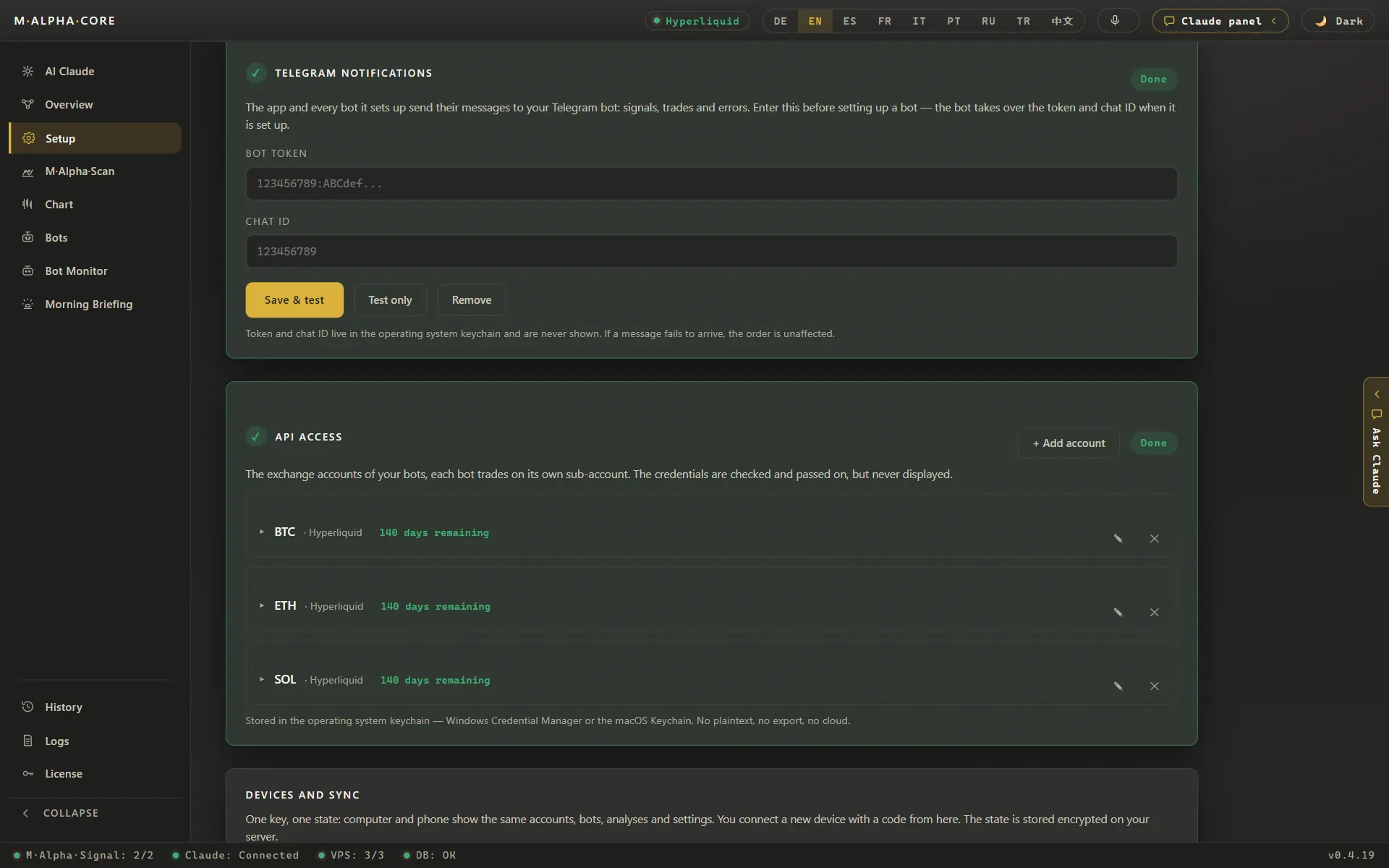
When you set up a bot, you can tick the dry run. The bot then runs on your own server like any other bot, receives every signal and writes down what it would have done, in its log and as a Telegram message for every signal. It sends no order to the exchange. You do not even need an exchange account or a key for a dry run: without an account, the bot counts with an imagined balance of $1,000.
Let the dry run go until two or three signals have arrived. Compare them with the chart: did the bot go long where the strategy said long, at the close of the right candle? Did the messages arrive on your phone? If yes, the chain from scan to signal to bot works.
One thing to know in advance: a dry run bot stays a dry run bot. It cannot be switched to real money later. For live trading you remove the practice bot and set the bot up again without the dry run tick. That takes a few minutes and keeps practice and real trading cleanly apart.
The testnet bot
A testnet is a separate copy of an exchange that runs with play money. Hyperliquid has one. In M Alpha Core you add a testnet account in the setup with the keys of your Hyperliquid testnet API wallet and mark it as a testnet account. Any bot on that account then trades for real, but only on the testnet. The app shows balance, positions and profit or loss of that account, so you see results in dollars, not only signals.
Keys from the real network do not work on the testnet and the other way round, so you create a separate API wallet there. Testnet trades do not appear in the trade history of your real accounts. Whether an account is testnet or real is fixed once a bot trades on it. For real money you use a separate real account.
What paper trading cannot show
- Real fills. A dry run assumes the order would have filled. A real order can fill at a worse price, especially in a fast market.
- Real liquidity. Prices and order books on a testnet can differ a lot from the real market.
- Your own nerves. Watching play money fall is easy. Watching your own money fall is not. Many people change their behaviour once real money is involved.
- Fees and funding exactly as they will be. The backtest includes fees, but the real costs depend on your account and the market at the time.
So treat paper trading as a check of the setup and a first look at live behaviour, not as a second backtest. A few weeks of paper trading cannot judge a strategy that makes around a hundred trades a year. For that, the report with its unseen part is the better tool. The guides on backtest on unseen data and out of sample testing explain why.
When to go live
A simple rule works for most people. If you are sure about a market and its report, start with real money and a small stake. If you are unsure, practise first. Practise until:
- two or three signals have arrived and match the chart,
- the Telegram messages reach your phone,
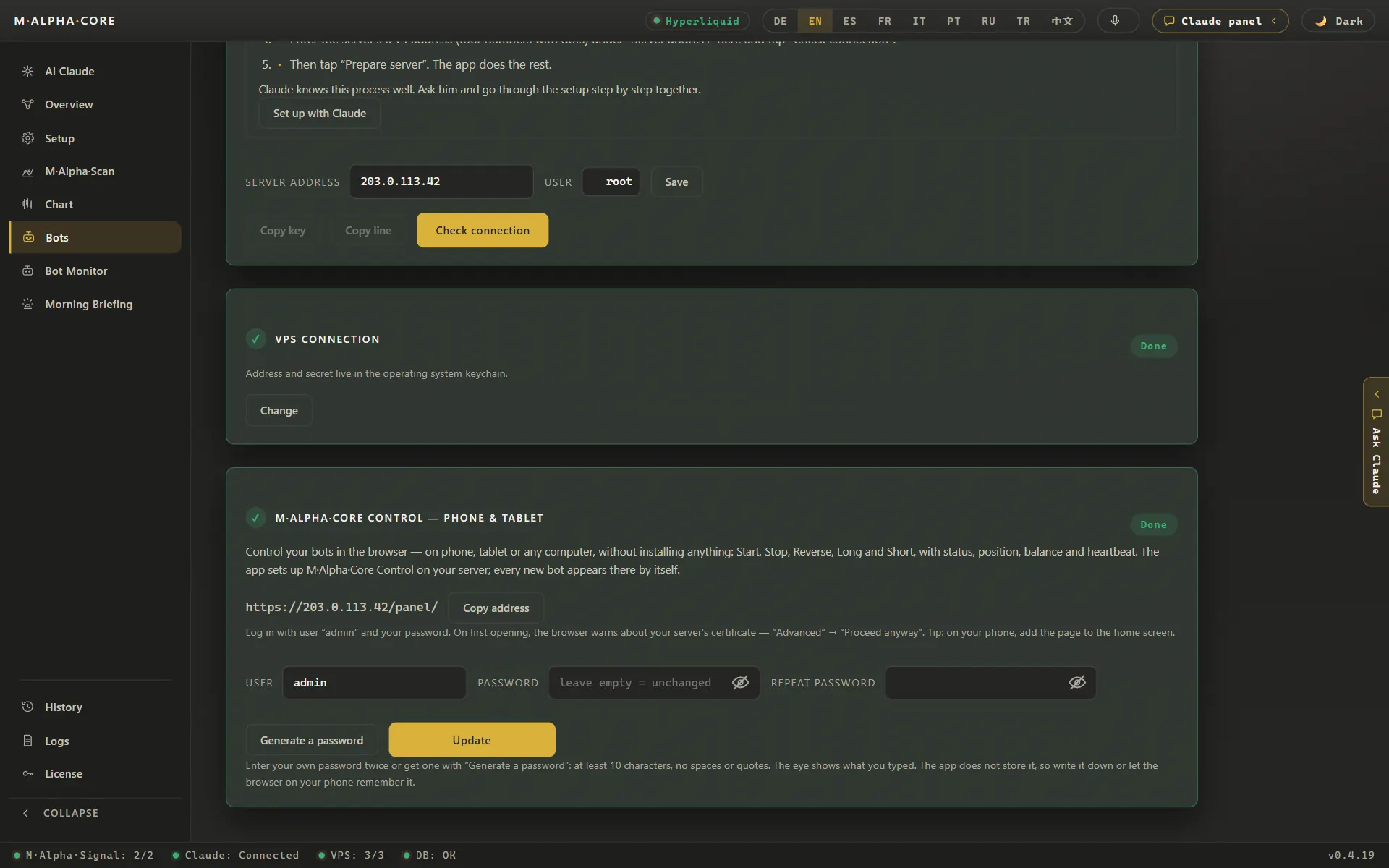
- you know how to set the bot to long, short, reverse or stop in the app or the browser control panel,
- you have decided on your leverage from the report, well below the leverage limit of the worst trade.
Then set up the live bot with a stake you can afford to lose completely, on its own sub account. Watch the first real trades closely. Every Sunday the app compares what the bot would have made on its own with what really happened on your account, which catches problems like high slippage early.
Use the practice time to understand the risk
While the practice bot runs, read the report once more. The worst move against a single trade is the number that decides whether a leveraged position survives. In an ETH example from M Alpha Core it was 15.64 %, so any leverage above 6.39x would have liquidated that trade. In our gold scan the limit was 18.2x, and in our S&P 500 scan 49.5x. Put your own numbers into the leverage and liquidation calculator and see where the liquidation price would be.
Is paper trading free?
The dry run and the testnet bot are part of the app. You need a license from $49 a month and your own small server for about $12 a month, just as for a live bot, because the practice bot runs on the same server. There is no separate free plan. The pricing page lists all costs.
Frequently asked questions
What is paper trading?
Trading with imaginary or play money on live prices, to check a strategy or a bot without risking real money.
What is the difference between a dry run and a testnet bot?
A dry run sends no orders and only records what the bot would do. A testnet bot places real orders on the Hyperliquid testnet with play money.
Do I need an exchange account for a dry run?
No. Without an account the dry run counts with an imagined $1,000.
How long should I paper trade?
Until two or three signals have arrived and match the chart, and you know how to control the bot. Paper trading checks the setup, it does not replace the backtest.
Can I switch a dry run bot to real money?
No. For real money you remove the practice bot and set it up again without the dry run tick.
Which exchange has a testnet in M Alpha Core?
Hyperliquid. You create a separate API wallet on the Hyperliquid testnet and add it as a testnet account.
Is paper trading free in M Alpha Core?
It is included in the license. There is no separate free plan, and the practice bot runs on your own server like a live bot.
Why can results differ between paper and real trading?
Real orders can fill at worse prices, liquidity differs, and fees and funding depend on the real market.
Do I have to paper trade first?
No. If you are sure about a market, you can start live with a small stake. If you are unsure, practise first.
Compare M Alpha Core
Side by side with other bot tools, with sources for every statement about them.
Exchanges in M Alpha Core: Binance · Bybit · Bitget · OKX · MEXC · Gate · BingX · KuCoin · Crypto.com · Hyperliquid
Related pages
All figures come from backtests on past market data. No result is a promise of future profit. Trading, especially with leverage, involves high risk. M Alpha Core is a software tool, not investment advice.