
Scalping bot: what it takes and why we trade longer charts
A scalping bot tries to earn small amounts on many short trades. It sounds simple, but fees, spreads and speed decide almost everything. This guide explains the arithmetic, the traps, and why M Alpha Core deliberately works on the 30 minute and 1 hour chart.
Last updated:
What scalping means
Scalping is trading for very small price moves, held for seconds or minutes. A scalper opens many trades a day, aims for a fraction of a percent on each and closes quickly. The idea is that many small wins add up, and that short trades carry less risk of a large move against you.
A scalping bot automates this. It watches 1 minute candles, tick data or the order book and fires orders much faster than a person could. Some scalping bots follow short term momentum, some fade small spikes, some try to earn the spread between buy and sell orders.
The arithmetic of fees
Every trade pays fees twice, once to open and once to close. On many exchanges the fee for an order that fills at once (a taker order) is in the region of a few hundredths of a percent of the position. That sounds tiny, until you set it against a target of a few tenths of a percent.
Take a simple example with round numbers. A bot aims for 0.20 % per winning trade and accepts 0.20 % per losing trade. Opening and closing together cost 0.10 % of the position. A winner then earns 0.10 % net and a loser costs 0.30 %. To break even, the bot has to win three trades for every one it loses, a win rate of 75 %, before slippage. If the fees were zero, a win rate of just over 50 % would be enough.
| Target per winning trade | 0.20 % |
| Accepted loss per losing trade | 0.20 % |
| Fees to open and close (example) | 0.10 % |
| Net per winner | 0.10 % |
| Net per loser | 0.30 % |
| Win rate needed to break even | 75 % |
An illustration with round numbers, not the fees of a particular exchange. Check the fee table of your exchange for real values.
Now compare a trade that aims for 3 % and accepts 1.5 %. The same 0.10 % of fees is a small slice of each result, and the strategy can be profitable with far fewer winners. The longer the average trade, the less the fees matter. That is the main reason M Alpha Core works on longer charts.
Spread, slippage and speed
- Spread. The gap between the best buy and sell price. A market order pays it on every entry. In thin markets it can be larger than the profit target of a scalp.
- Slippage. In a fast move, an order fills at a worse price than the one on the screen. Scalps happen exactly in fast moves.
- Latency. Professional firms place their servers next to the exchange and react in microseconds. A private bot on a rented server reacts in milliseconds at best. On very short time frames, you are competing with them for the same small moves.
- Funding. Less important for trades of minutes, but part of the bill on perpetual contracts.
Why scalping backtests mislead
A backtest on 1 minute candles knows only open, high, low and close of each minute. It does not know in which order the price moved inside the minute, so it cannot tell whether a stop or a target was hit first. It usually assumes fills at the candle price, with no queue and no slippage. For a strategy that aims for 0.2 %, these small errors are as large as the edge itself. A scalping backtest can look excellent and lose money from the first live day.
Overfitting is also easier. A year of 1 minute candles holds more than half a million candles. A search over many settings will find patterns in that much noise that never repeat. A test on data the search never saw is the minimum, and even that cannot fix wrong fill assumptions. The guides on out of sample testing and how to backtest a trading strategy explain these traps in more detail.
Why M Alpha Core trades 30 minute and 1 hour charts
M Alpha Core is not a scalping bot, and we say so plainly. Its built in strategy, M Alpha Signal, decides at the close of 30 minute or 1 hour candles. A scan can search both time frames in one run and keep the better one. Trades usually last hours to days. We chose this for four reasons:
- Fees stay small compared with the size of each trade.
- The backtest is closer to reality. On longer candles, fill assumptions matter far less.
- Speed does not decide. A signal at the close of a 1 hour candle does not need a server next to the exchange. Your own small server is fast enough.
- The test means something. With around a hundred trades a year, the split into a searched part and an unseen part leaves enough trades to judge, without drowning in noise.
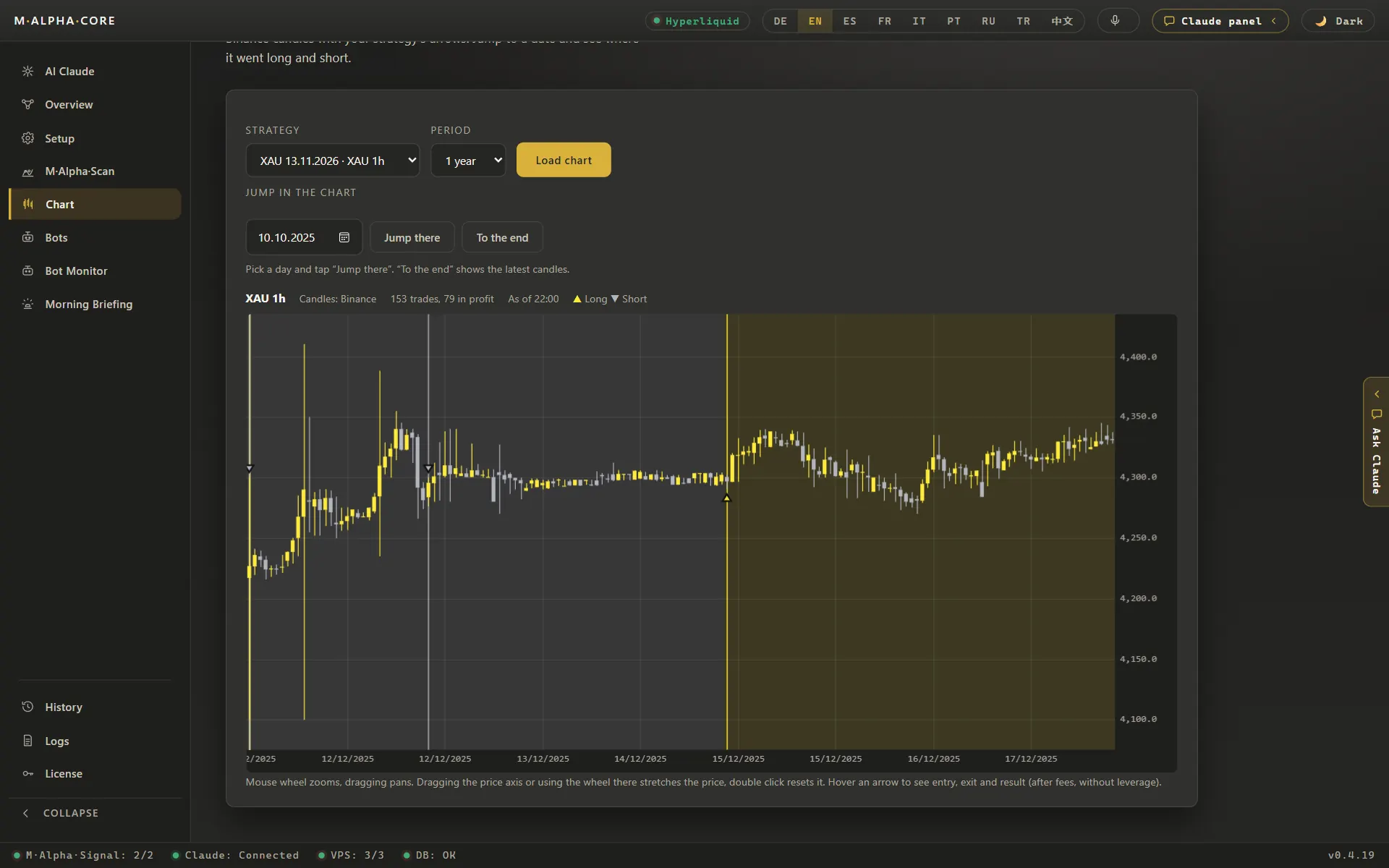
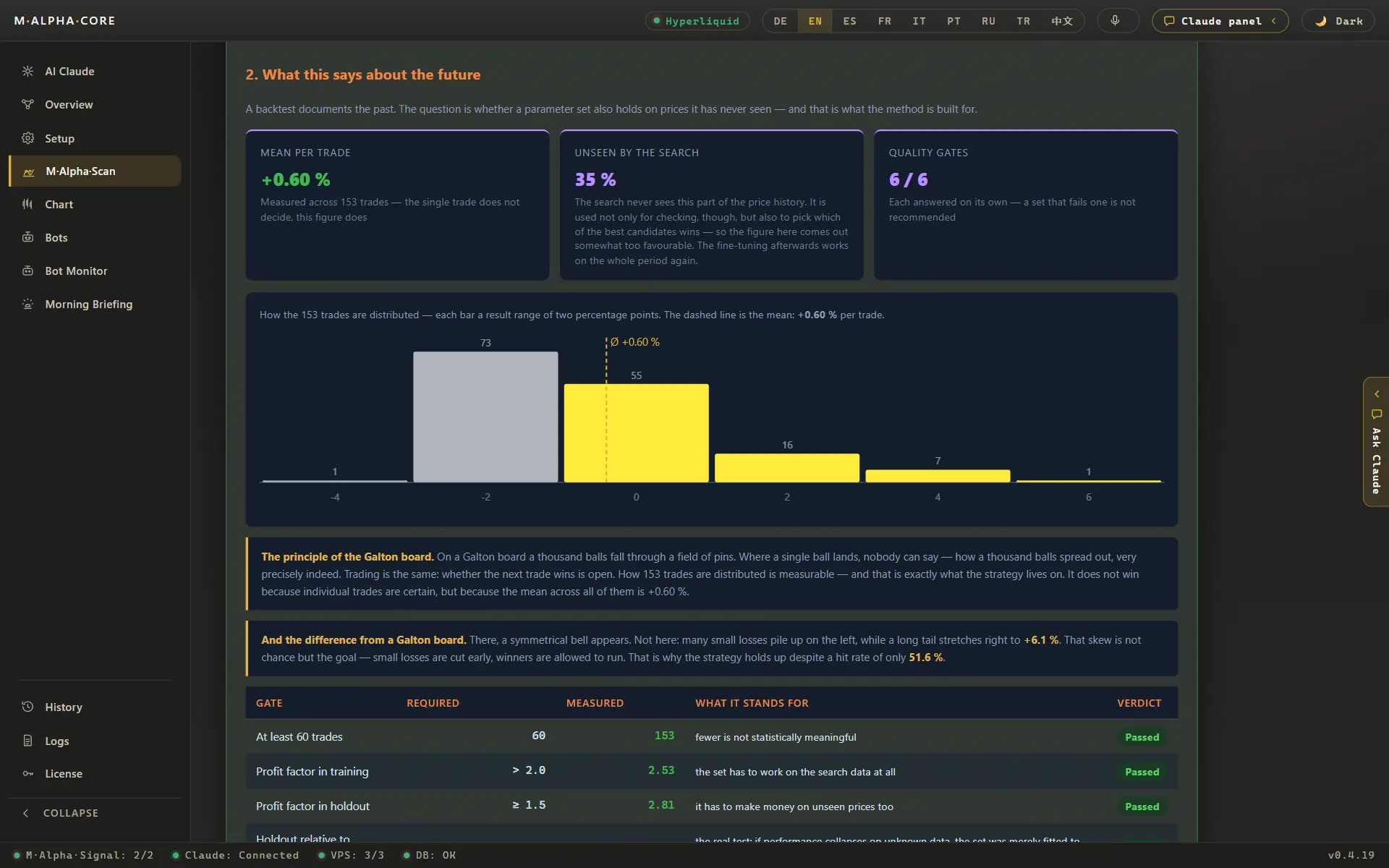
Our published scans show what this looks like: gold on the 1 hour chart with 153 trades in the test period, the S&P 500 on the 30 minute chart with 91 trades, an ETH example with 116 trades. That is a few trades a week, not two hundred a day.
If you still want to scalp
Scalping is not impossible, but it is a professional business. If you want to try it:
- Use maker orders where you can, because they usually pay lower fees.
- Trade only the most liquid markets with the smallest spreads.
- Backtest with tick data and realistic fills, including slippage.
- Paper trade on live prices for a long time before real money, because the gap between backtest and live is larger than anywhere else.
- Count every cost: fees, spread, slippage, funding and your server.
For most private traders, a slower strategy with a tested edge and fewer trades is the more realistic path.
Scalping and leverage
Because the targets are small, scalpers often use high leverage to make the results worth the effort. That makes every mistake expensive: one slipped stop at 50x can cost more than a week of wins. On longer charts leverage is a choice you can measure. The report of M Alpha Core shows the worst move against a single trade and the leverage that move would have survived, for example 6.39x for a worst move of 15.64 % in an ETH example. Check any leverage with the leverage and liquidation calculator.
What M Alpha Core offers instead
A scan that finds the best settings of the built in strategy for your market on the 30 minute or 1 hour chart, a report with the check on unseen data and the risk in numbers, and a bot on your own server that trades around the clock with your trading only key. Every trade is reported to your Telegram, and a control panel in any browser lets you set long, short, reverse or stop. The methodology page explains how the figures are calculated, and the pricing page lists all costs.
Frequently asked questions
Is M Alpha Core a scalping bot?
No. Its built in strategy trades the 30 minute and 1 hour chart. Trades usually last hours to days.
Why do most scalping bots lose money?
Fees, spreads and slippage take a large share of very small profit targets, and backtests on short candles often assume fills that do not happen live.
How much do fees matter for scalping?
A lot. In a round number example with a 0.20 % target and 0.10 % fees per round trip, a bot needs to win 75 % of its trades just to break even.
Can I set M Alpha Core to a 1 minute chart?
No. The scan works on the 30 minute and 1 hour chart, which keeps fees small compared with each trade and the backtest close to reality.
Is a high win rate enough for scalping?
Not on its own. The size of wins and losses after fees decides the result, which the profit factor shows.
Does scalping need a fast server?
Very short scalping competes with professional firms that sit next to the exchange. A signal at the close of a 1 hour candle does not.
How many trades does M Alpha Core make?
It depends on the market. Our published examples have 89 to 153 trades in their test periods.
Can a scalping backtest be trusted?
Only with tick data, realistic fills and a test on unseen data. Even then the gap to live trading is large.
Is high leverage normal for scalping?
It is common, and it makes every slipped stop expensive. Choose leverage from the worst move of a tested strategy.
Compare M Alpha Core
Side by side with other bot tools, with sources for every statement about them.
Exchanges in M Alpha Core: Binance · Bybit · Bitget · OKX · MEXC · Gate · BingX · KuCoin · Crypto.com · Hyperliquid
Related pages
All figures come from backtests on past market data. No result is a promise of future profit. Trading, especially with leverage, involves high risk. M Alpha Core is a software tool, not investment advice.